ABOUT
Nikola Mihajlović
I paint in Belgrade, and I came to painting from working on walls. My first works, made in 2015 and 2016, were built with the materials I used outside: façade paint, wood glue, and sand on OSB board. Mass reached the picture from the wall before it reached it from the palette. I have painted murals ever since, across Europe and in Asia, and they are not a sideline. The wall is where my surfaces come from.
Kori is a nickname. I signed the early work with my given name and later moved to Kori, which is how I sign now.
I trained as an architect. Architecture is the discipline of the drawing that precedes the object: you do not make the thing, you make the drawing of the thing, and somebody else builds it. In more than a decade of painting, I have never made a drawing that precedes a painting. No studies, no sketches on paper, no working drawings. Where drawing happens, it happens as the first layer of the canvas itself. Nothing is scraped off either. What I paint over stays in the painting. I want the whole process recorded on the surface.
The basic operation has been the same since 2017, and it is closer to carving than to composing. I prefer to stand in front of a white canvas with no picture in mind. A layer goes down spontaneously: poured, rolled, brushed, sprayed. Then I lay flat color over and around it, taking territory away from the gesture. What the flat color fails to cover becomes the form.
I repeat the operation, sometimes several times, until the shape cut out of the mass holds. The last flat application decides the contour, sometimes closing on the mass, sometimes stopping short and letting it breathe. I then work into the form from inside it, with sharp lines that give it sides and depth.
So the form is not drawn and not composed. It is what survives. A different covering would have left a different figure.
I decide the color under the same conditions as the form: never in advance. I mix the flat field in front of the painting, in response to what is already there. Getting it right is one of the most demanding decisions in the process because that color closes both the image and the process. If it does not work, I repaint the field while keeping its edge. Only when part of an earlier field is allowed back into the form does the contour change. Color and boundary are therefore separate decisions, even when the final application determines both.
The gestural layers operate differently. Their color often begins with whatever is physically at hand: remnants of earlier mixtures, nearly empty tubes and bottles, colors left over from other paintings. They enter as material before they become a chromatic decision.
That operation also became a way of working through the division in my own practice. My architectural training had developed one half of the process far beyond the other: constructing, measuring, deciding an edge in advance came into the studio already fluent. The impulse that moves before it can justify itself was equally present, but I hadn't given it the same attention.
In 2021 I stopped trying to hold the two together. In Towards Radical, on paper, I took the less controlled side of the practice and gave up defined form altogether. I also changed from acrylic, which dries fast and closes, to oil, which stays open and keeps moving under the hand. The research continued onto canvas in Distances, and again, differently, in Introspection, where light enters from the edge and, for the first time, comes from canvas left bare.
The recent work brings both sides back onto one surface. What has changed is who decides.
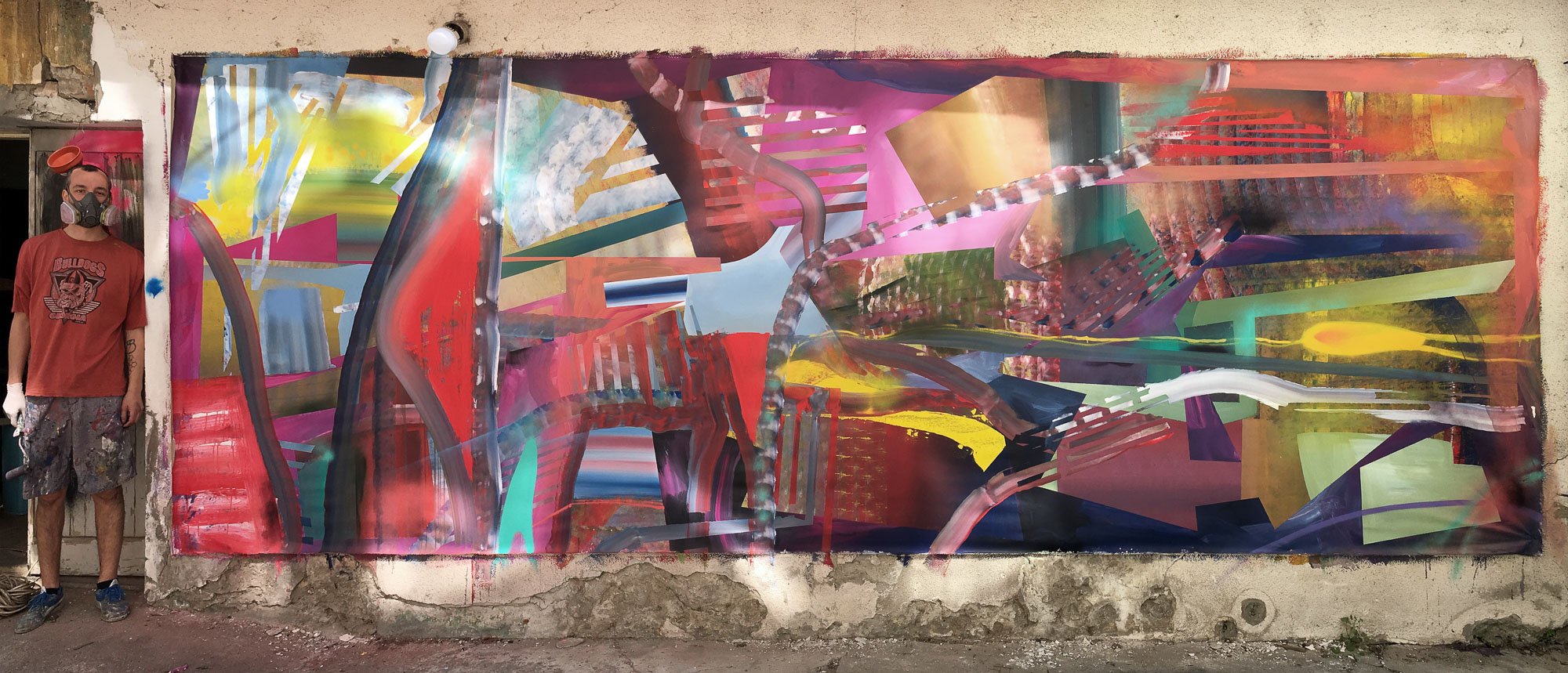
Field, 2018, acrylic and spray paint on canvas, 210 × 600 cm
One canvas explains more about how I work than any single painting. In 2018, I hung a two-by-six-meter canvas on a wall and worked it standing, using a roller, a brush, and spray, with nothing in mind and no intention of finishing it. I never signed it or showed it. When it was dry, I cut it up. I stretched each piece as I cut it, then finished them separately over the following years, in different series.
In Enclosures, the cut pieces were reduced by flat color in the usual way. In Preserve, the operation runs backward: a form is found by joining points across a drawn grid, cut out with a scalpel, and protected while everything around it is painted. The figure there is a piece of that older surface, with nothing added to it.
The format of those paintings is not a rectangle they were made to fill. It results from where the blade went.
Biography
Nikola Mihajlović (b. 1986, Belgrade), who also signs as Kori, is a painter and muralist based in Belgrade. He holds a master's degree in architecture from the University of Belgrade and has painted murals and public walls across Europe and in Asia since 2015.
His solo exhibitions include Cosmic Noise (U.K. Parobrod, Belgrade, 2016), Dimensional Interweaving (Espace Témoin, Geneva, 2018), Transmutation (Bioskop Balkan, Belgrade, 2021) and Distances (LAG Gallery, Belgrade, 2023). Group exhibitions include Traces: Street Art of Serbia and France 1995–2022 at the Serbian Cultural Center in Paris (2023). He was a resident at Glo'Art, Lanaken, in 2018.
From 2012 to 2013, he managed the restoration of frescoes at the monasteries of the Peć Patriarchate, Gračanica and Dečani, under UNESCO auspices. His work is held in private collections in Serbia, Switzerland, Belgium, Italy, and the United States.